
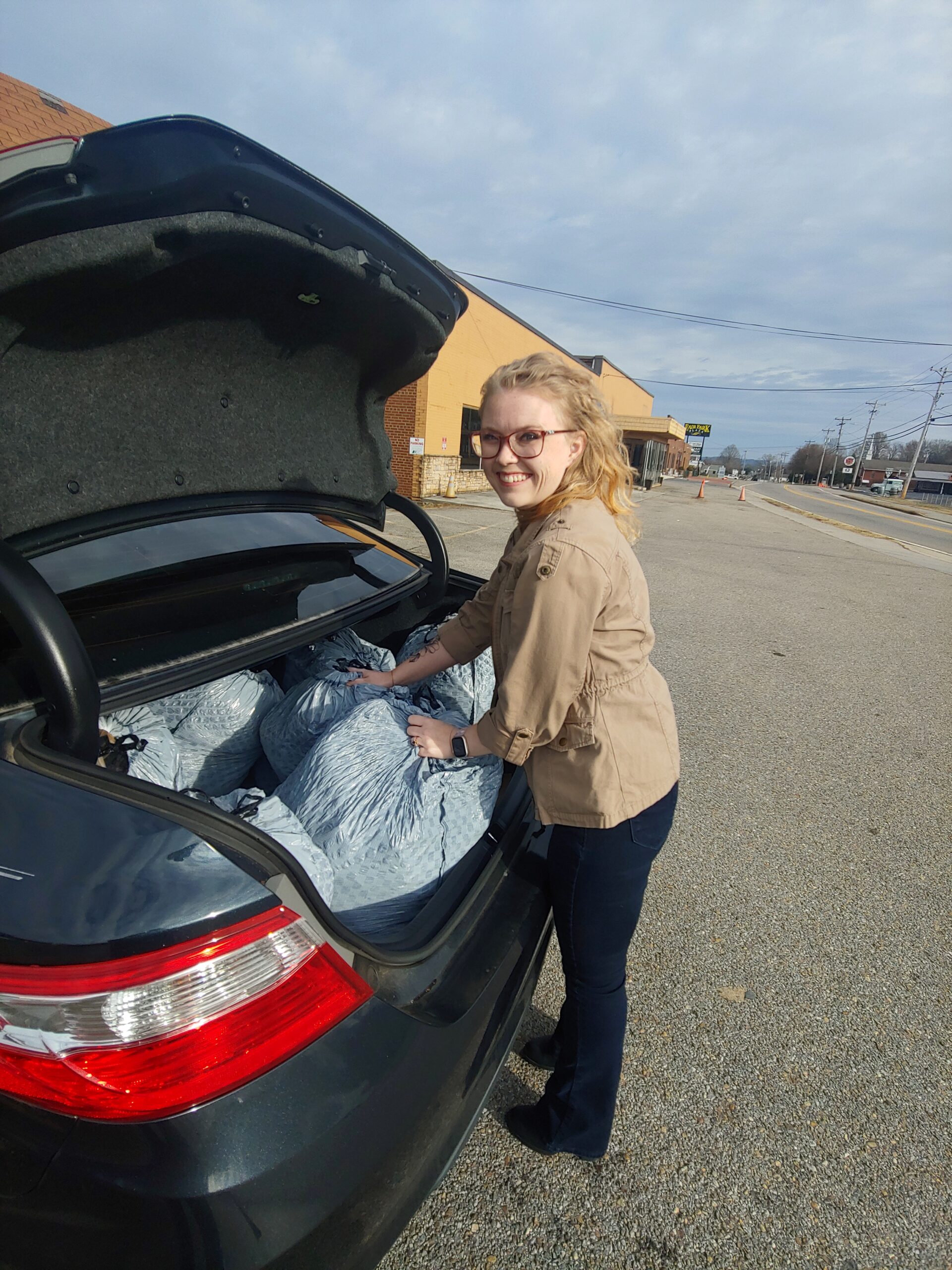
With cold weather’s arrival, many of us relish cozying up with warm drinks and toasty blankets. The season is much harder for our unhoused neighbors, however. That’s where the Tennessee Valley Coalition for the Homeless comes in.
The nonprofit is collecting items needed to help unhoused folks weather the winter. Needed donations include winter clothing (coats, pants, hats, gloves, etc.); survival gear (backpacks, sleeping bags, tarps, etc.); and ready-to-eat, non-perishable food items. It’s important that food donations be ready-to-eat and do not require cooking or appliances like can openers.
Katelyn McGuire, Executive Director of Tennessee Valley Coalition for the Homeless, said that donated items can be dropped off at Southland Books (1505 E. Broadway Ave.) or The Bird and the Book (1509 E. Broadway Ave.), at the Five Points Roundabout. “If you have a large donation,” she added, “please get in touch with TVCH at info@tvceh.org to arrange a drop off.”
The donated items go directly to homeless people via the Coalition’s Street Outreach and Mobile Shower Trailer programs. Those programs “serve unhoused neighbors in our counties,” McGuire explained.
The Tennessee Valley Coalition for the Homeless “provides street outreach and mobile showers to unhoused neighbors, operates a Permanent Supportive Housing program for individuals who have experienced chronic homelessness and are living with a disability, and staffs a Regional Homelessness Assistance Helpline to connect those in need with the resources that best fit their situation,” McGuire said. “In 2024, TVCH provided over 35,000 services to almost 1,300 individuals across our 12-county service area.”

That service area includes Anderson, Blount, Campbell, Claiborne, Cocke, Grainger, Hamblen, Jefferson, Loudon, Monroe, Sevier and Union counties.
The Coalition also accepts monetary donations to aid in its mission. “You can also donate to our 2025 Doubly Devoted Fundraiser,” McGuire said. As part of that fundraiser, “local supporters match community donations, allowing your donation to go twice as far.”
Monetary donations assist in a variety of ways, she added. “Your gift also helps us grow our team and strengthen our organization’s foundation. Donations support staff development, program operations and the tools needed to expand our reach across the region. Contributions also help us build flexible funding to assist people whose needs fall outside of traditional program coverage.”
McGuire is inspired by “watching the communities we serve uplift our work and support what we do, whether they are hosting fundraisers, advocating or volunteering with us.” These partnerships empower the Coalition’s mission, she added. “Without the support of our community members, we wouldn’t be able to provide our current scale of services. When organizations, community members, policymakers, faith leaders, and other stakeholders work together, we really see change at the local, state, and national levels.”

TVCH serves as the lead agency for the regional Continuum of Care, or CoC, she explained. “The CoC is a collaborative network of agencies, nonprofits, and community partners working together to end homelessness across our region. As the lead, TVCH coordinates data collection, manages federal funding and ensures that communities are using effective, evidence-based approaches to make homelessness rare, brief, and non-recurring. This leadership role allows us to align resources, strengthen local partnerships, and improve outcomes for individuals and families across all 12 counties.”
The Continuum of Care helps coordinate the “Point in Time” census of homeless populations each year. In 2024, they found that 784 people in the service area are homeless. An additional 181 were “precariously housed” but did not meet the federal definition of “homeless.” Among the unhoused, 30% were disabled, and 2% were veterans.
Winter is of course a very dangerous time for homeless populations, who may be experiencing other health issues that are complicated by cold weather.
For more information about how you can help those in need, visit https://tvchomeless.org/give-help/.