
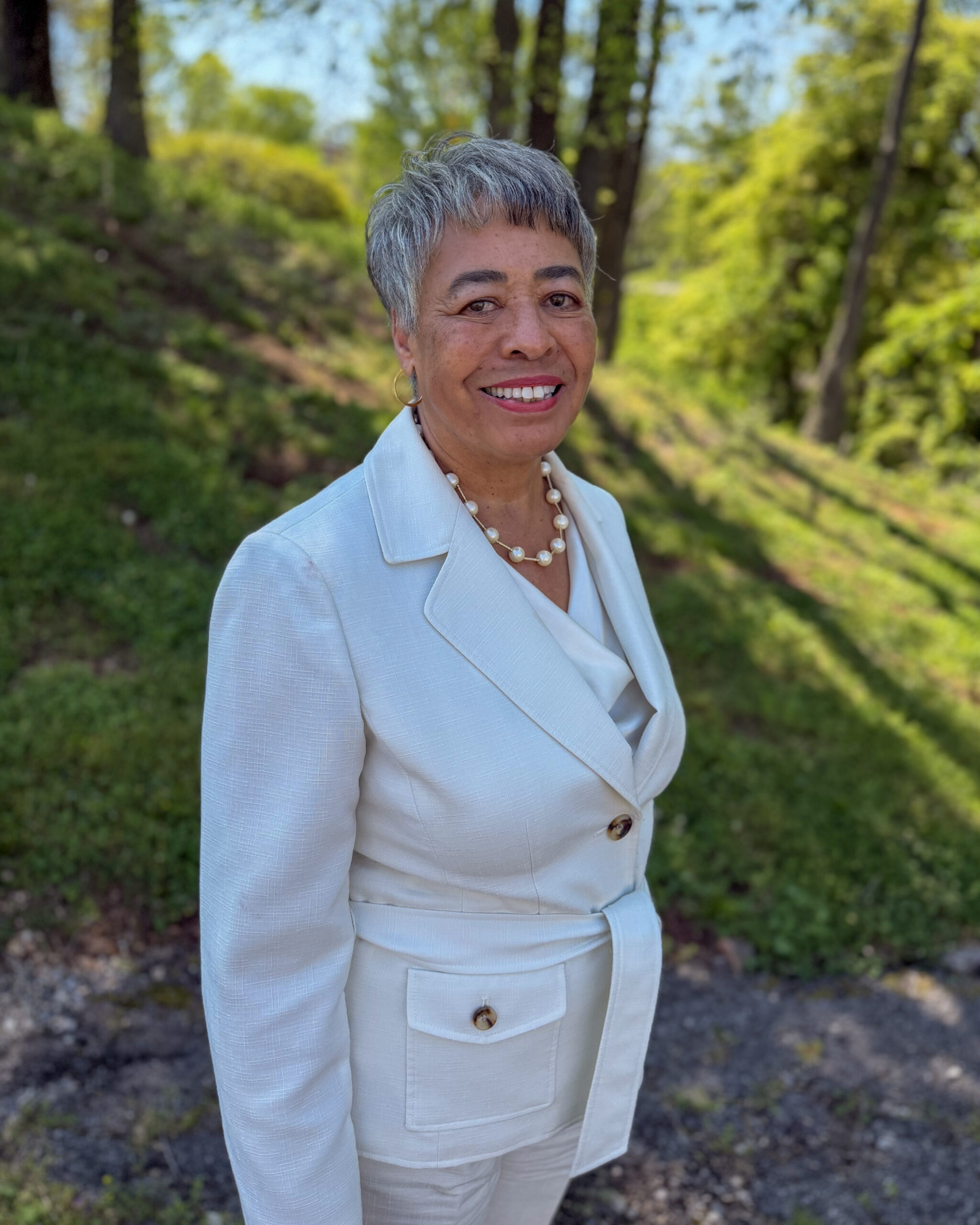
Spend five minutes in a room with Sharon Hannum, and you’ll feel it.
You’ll feel her confidence, her power, and her boundless energy. You’ll know, deep down, why Hannum’s presence, insight, and work are sought after in Blount County, Tennessee, her lifelong home.
But Hannum’s story is also one of complexity, of difficult choices, perseverance, family, and faith. Becoming a successful business woman is an uphill battle by itself, but try becoming a successful black business woman in East Tennessee. Hannum has faced bigotry and adversity and emerged victorious.
“You may look at me as a second-class citizen, but I am a citizen,” Hannum said. “I have a right to be here. I have a right. I have a reason, and I have a responsibility.”
Hannum grew up two blocks from Maryville High School, in Maryville’s historically black community called “The Creek.” The community was located near today’s greenway valley near Harper and McGhee streets. She attended W.J. Hale School and went to church at St. Paul AME Zion, where she still attends today. Now, all that is left of the community is the church, as the homes, the shops, and the community itself were taken by the city of Maryville through eminent domain.
Hannum was 11 years old when older black students desegregated Maryville High School, a select few of the best and brightest W.J. Hale had to offer.
“It was horrifying for them,” she said. “But they trailblazed.”
Hannum felt the lingering effects of school integration when she attended Maryville Junior High School and all the way through her graduation from Maryville High School in 1969.
“It was not fun times,” she said. “Nobody wanted us there, still. It never once occurred to people that we didn’t want to be there.”
Hannum doesn’t shy away from the complexity she experienced during desegregation and throughout her life. She said desegregation also brought loss.
“To some degree, it is my belief that integration didn’t really help our people,” she said. “It made it almost impossible to grow back what was taken (through eminent domain). It put us in pockets here, there, and everywhere. We suffered economically and strategically.
“It is ironic to me that our homes and our businesses were taken and replaced with affordable housing units, but there were no black people in them.”
Hannum’s father passed away in 1970. At that time, she considered following other family members to Detroit or Atlanta, but she quickly realized that her mother would not thrive living on her own.
Then, in 1973, on the anniversary of her father’s death three years earlier, Hannum welcomed her son, Robert Todd Hannum, into the world.
“The Lord giveth, and the Lord taketh away,” she said. “(Todd) has a lot of my dad’s mannerisms. He can take what hurts and turn it into something beautiful.”
“God was saying to me, ‘If everybody leaves, who will stay and put things back together again?’” said Hannum. “You have to choose whether you’re going to be a perpetual victim or not. I continue to stay out of choice.”
Hannum began her career as a teller at Blount National Bank, and then worked at Carborundum Company in Knoxville, but the travel requirements there kept her away from her son too much. A previous customer from Blount National recommended her to human resources at the Alcoa plant, now Arconic, during a time when they were intentionally hiring women into nontraditional roles.
At first, she wasn’t interested, but after the third time they asked her, she came on as a foreman. Those first years were hard. She worked night shifts to be available for her son, meaning three to four hours of sleep per night. She took in four nieces and nephews when she was 25 years old, one of whom she formally adopted.
And of course, there was the reality of working as a black woman in role previously held by men only. She confronted racism and sexism, at one point facing down the men who burned a cross on her car hood in the plant parking lot, and at another showing a male supervisor the error of his casually sexist ways.
“I wasn’t willing to be there and be mistreated,” she said.
She eventually moved from production to maintenance and ended her 30-year career with the title Senior Planner. Among her accomplishments, she developed a relationship with the unionized employees that no one else had achieved.
“Had they been treated fairly to begin with, we wouldn’t have needed a union,” she said.
In the meantime, Todd had grown up and moved away, and Hannum once again felt the sting of lost community.
“I knew when he left that he would not return,” she said. “There was nothing for him here. (Blount County) is still not a draw for young adults, but I don’t want to remain silent and not do anything, so that other mothers have to go through what I went through.”
Instead of leaving, Hannum stayed, blessing the community over and over with her willingness to speak up. A judge asked her to be a jail inspector at the Blount County Correctional Facility, and once again, she said no three times before realizing that God was telling her to say yes.
Immediately, she saw problems. The jail was overcrowded, and recidivism rates were high, with few programs to help people re-enter life outside.
“In there, you are charged with something. You’ve not had your day in court. You’re just sitting there,” Hannum said. “Once you get in the system, it’s almost a spiral. While you were in there, you’ve lost your job, your car, your housing. Some of it is their own fault, but paying that penalty over and over again for the rest of your life is a travesty.”
She talked with the sheriff and advocated for change, gathering people to the cause and implementing ways to help inmates become positive contributors to the community once they leave jail. Today, Blount County’s jail is one of the only jails in Tennessee certified on all points of reentry, recidivism rates have dropped, and the jail is no longer overcrowded, Hannum said.
“It’s because of a concerted effort from the top, down,” she said. “You’re more than what’s written on a piece of paper. You have made mistakes, but that doesn’t make you a mistake. It took someone willing to tackle the hard stuff. The sheriff didn’t have to talk to me, but he did.”
In addition to her work in the jail, which has led her to become a court advocate and chaplain, Hannum is the only member of the Blount County Budget Committee who is not a member of the County Commission. She also leads Women in Business at the Blount Partnership, has served on the Haven House board of directors, and is involved in many other community organizations.
“God himself placed me,” she said. “I don’t go because I want to. I do it because that is what God has equipped me to do. That’s what He gave me spiritual gifts to do.”
Hannum’s vision for Blount County’s future is different from what she sees as its current trajectory. She would like to see more diversity, more culture, and more opportunities for young people.
“I would love to see a community that are not just welcoming with their lips, but also with their actions,” she said. “When they are recruiting to this area, I wish they would consider that it’s not just about anybody who can fit into a square, but that we would be intentional about what our community really needs here, intentional about inviting every age group and demographic, not just one community or color only.
“If we’re going to have all this overcrowding, I’d like at least to not have it to where people are hiding in the four quarters of this community and segregate again. We don’t need fringes. We need everybody to have affordable, attainable housing and not $2 million homes.”
But that will take work, and the work won’t be easy, she said.
“We’ve got to get over thinking that everything you want is easy to come by. If we don’t care enough to change where we live, why do we stay? If you really want to make a difference, somebody’s got to fight the fight. You have to care enough to do it in spite of your fears. You have to care enough to do what you have to do.”
Just like Hannum has done, over and over again.