

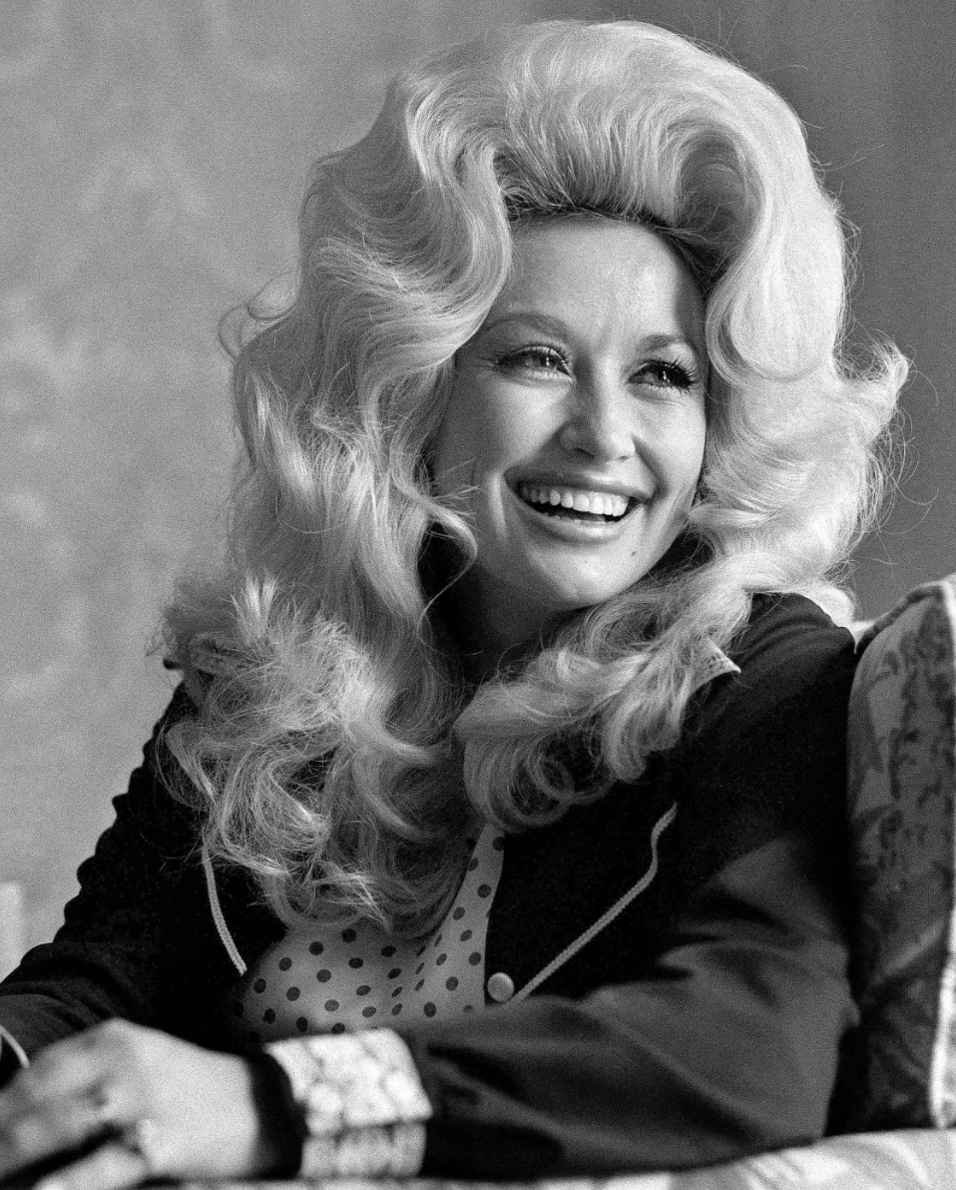
It’s hard to say for certain what led Benjamin Christopher Parton — the third great-grandfather of country music legend and all-around pop culture icon Dolly Parton, who died this week at the age of 80 — to lead his family into the rugged hills of Sevier County rather than those of neighboring Blount.
Most likely, family connections drew him there. The Parton family would become intertwined with the Emerts, one of the pioneering families of the Great Smoky Mountains. Johan Frederick Emert, an early White settler of the region, claimed land in a cove that still bears his name today, just south of the community that would become Greenbrier. For generations, the Partons, Emerts, Evanses and Lees would call this rugged terrain home, their lives intertwined with the mountains, creeks and coves of Southern Appalachia.
It was a world that, generations later, would be immortalized by Dolly Parton.
The mountains were everywhere in her work, especially in the people who populated her songs and stories: poor people and proud people, hard-working farmers and dreamers, mothers trying to hold families together and children trying to imagine a life beyond the narrow horizons they had been handed. They were in the humor, the heartbreak, the music and the stubborn resilience that became as much a part of her public identity as the rhinestones, the wigs and the impossible silhouette. And eventually, they would become the foundation of an empire, from songs that carried the voices and vernacular of Southern Appalachia around the world to the massive theme park that remains a vital part of Sevier County’s economic identity.
But while Sevier County was Dolly Parton’s ancestral home and the landscape most closely associated with her remarkable life, Blount County can still lay claim to a small but meaningful piece of her legacy.
The mountains, after all, have never cared much for county lines.
They rise and fall across imaginary boundaries, their ridges disappearing into one another beneath endless banks of low-hanging mist. Hollers become valleys, and creek branches rush over ancient rocks through small pockets of civilization where subsistence farming was the only way of life for generations. Roads that may begin in one county eventually wind their way through another, carrying families, stories, songs and shared history along those endless curves and harrowing switchbacks.
And somewhere in those tendrils of mountain laurel and fog is the thread that binds all of the counties that make up the western boundary of the Great Smoky Mountains — a shared Southern Appalachian spirit forged as much by necessity as by geography.
It is a spirit of hard work and hard times, music and memory, faith so deeply rooted it can sustain a family through almost anything, and independence so fierce that even the people who profess that faith may spend a lifetime arguing about precisely what it means.
It is the spirit of people who understood poverty but refused to accept humiliation, who recognized the limitations of the places where they were born, and who nurtured a young girl who possessed an almost irrational certainty that the world beyond the mountains might have room for her, too.
Those early years carved her heart in ways that would touch millions of people once she found her place in that world. Her generosity was born not necessarily from abundance, but from remembering what it feels like to need; the humor in her work was born from a survival mechanism; and the pride she always felt was the deep and occasionally defiant pride of people who know exactly where they come from and refuse to allow anyone else to tell them what that place is worth.
Dolly Parton was their champion. Their herald, and in her stubborn refusal to believe that where you come from should dictate how far you can go, the course of an entire family’s destiny was forever changed.
She was born into it on Jan. 19, 1946, the fourth of 12 children born to Robert Lee Parton and Avie Lee Owens Parton. The two-room log cabin on Locust Ridge that the family called home offered little in the way of material comfort, but it gave her something that could not be bought or manufactured later: a seemingly inexhaustible supply of stories, characters, music and memories. The mountains gave her a language, but her family gave her a mythology. Poverty gave her perspective, and somewhere between the songs she heard growing up, the stories she absorbed and the dreams she began to nurture as a little girl, Dolly Parton set her sights on a life that would carry her far beyond the rough-hewn ridges that surrounded that cabin.
The remarkable thing, of course, is that she never really left them behind. Physically, she set out for Nashville the day after she graduated from Sevier County High School in 1964. She would go on to conquer Music City, then Hollywood, then Broadway, and then virtually every other corner of American popular culture.
She became a singer, songwriter, actress, author, businesswoman, philanthropist and one of the most recognizable human beings on the planet. She wrote songs that became standards, built an entertainment empire and used her wealth to put books into the hands of children who might otherwise never have owned one. And because she carried East Tennessee with her wherever she went, the impact of her death this week has been unimaginable across the region that claimed her just as fiercely as she claimed it.
“It’s the closest I’ve come to crying over someone’s death (since my late wife, Alma, died in 2013),” says Roy Garrett, the 92-year-old former proprietor of Roy’s Record Shop. A fixture in downtown Maryville for 40 years, the store made Roy something of a celebrity in local music circles, and when he closed the doors on Dec. 31, 2005, he recounted the famous faces who had passed through it over the years, including numerous members of the Parton family.
“It was such a shock. I know some close friends of hers, and they told me about her condition, so I was kind of expecting it … but even when we heard, I was in shock just like everybody else,” Roy adds. “I went out and immediately dropped my (American) flag to half-mast, and when I came back in and turned on the TV, I saw that the president was ordering all flags to be lowered to half-mast starting at 6 o’clock that evening. Well, I was ahead of him, because I had already lowered mine.”
By the time Roy and Alma Garrett moved to Blount County, where Alma was born, in 1965, Dolly was already a fixture in East Tennessee. Legend has it she started writing songs at 5 years old, and her uncle, the Rev. Jake Owens, organized the members of his extended family, including Dolly, into numerous gospel groups that performed around the region. Her Uncle Bill Owens saw Dolly’s talent for what it was, and in 1956, backstage at a WIVK radio show, the 10-year-old met another East Tennessee legend, businessman and radio/TV personality Cas Walker.
A grocery store magnate, Walker created a radio show called the “Farm and Home Hour” to promote his chain, and in its early years, it featured numerous country musicians who would go on to national notoriety, including Roy Acuff, Chet Atkins, Carl Smith and, after it transitioned into a locally broadcast TV show, Parton herself. Mentored by her Uncle Bill, she became something of a local celebrity and released her first single, “Puppy Love,” in 1959 — featuring guitar work by Blount County’s Marvin Russell.
Russell, who died in 2023, taught guitar around Blount County in 1965, but even before then, he was a renowned picker, having spent time on the road with Wilma Lee and Stoney Cooper, a popular country music duo from the 1940s through the 1960s. On one radio show, the legendary George Jones needed a backing band — so Wilma and Stoney loaned him theirs, and Marvin ended up playing for “The Possum.”
It’s little wonder, then, that in 1959, Uncle Billy reached out to Russell and asked him to do some session work for his then 13-year-old niece. He played on “Puppy Love” and its B-side, “Girl Left Alone,” further proof that Blount County’s ties to Dolly Parton go back to the very beginning. (Those songs, and Russell’s contributions to them, can be found on Parton’s retrospective compilation album released in 2004, “Dolly Parton — The Early Years.”)
By 1961, she had caught the attention of another name famous in Blount County music circles: Tommy Covington. For decades, he owned and operated Tommy Covington’s Music in downtown Maryville, and he was a member of the house band for the “Mid-Day Merry-Go-Round,” a pivotal radio show in the history of country music that aired on WNOX-AM and broadcast from 1936 to 1961. The experience likely inspired Covington to start his own program, “Hayloft Jamboree,” which was broadcast on WGAP-AM in Maryville. Around 1960, Covington invited Dolly to perform on the show … and a recording of part of that performance exists today.
(It must be noted that the recording also serves as something of a Blount County time capsule: The segment opens with Covington (it’s assumed) urging listeners to “do a little trading” with the sponsors of the program, including Dixie Supermarket, “up on the corner of Washington and Ellis, what all us old-timers used to call that part of the town the Southern Depot …”)
From the preserved recording, Covington hints that Dolly’s performance has been requested by the show’s fans, and he describes her as “the pretty little girl that you see on television a whole lot.” When she launches into “Another (Just Like Me),” the voice is unmistakable, and while the girl singing it looked nothing like the big-haired, rhinestone-studded star she would grow into, the applause when the song concludes is evidence of her star power, which Covington succinctly pointed out: “Well, I don’t think Dolly Parton’s got anything to worry about, because there will never be another one like her!”
Covington would bring Dolly back around in 1961 for another program he hosted, the “Tuckaleechee Barn Dance Jamboree,” which took place at the Central Dance Hall in Townsend, and shortly afterward, her career blasted skyward. She had a publishing arrangement with Tree Publishing while still in high school, but after moving to the town that took her in a day after graduating high school, she would go on to sign an agreement with Combine/Monument in early 1965 that established her as a bona fide songwriter.
Uncle Billy was part of that deal, and back home in East Tennessee, other members of the Parton family began exploring their own musical possibilities. Dolly had opened the door, and while no one would enjoy the level of success she did, that didn’t stop them from getting in on music action … and by that point, Roy and Alma were there to help them as much as they could.
“In the ’60s and ’70s as Dolly began to grow, John Henry Owens III’s boys (Dolly’s uncle, the sons of whom are her cousins), began coming in the store a lot,” Roy says. “Her mother and her sisters did a gospel album, and they came by my store for some promotional pictures on the album cover. Just about all of them would put out some sort of record, and I would do my best to sell them, even though most of them were unknown.
“That went on for five or 10 years, and Dolly sent me a very nice autographed picture thanking me for all the help I gave them.”
There was a single occasion that Garrett got to meet Dolly in person, back when a friend invited him to a backstage WIVK shindig where Dolly was in attendance. It was a happening party, and he paused momentarily with the young star to get his picture taken … but when the negatives came back, Garrett saw that the photographer had cut off his and Dolly’s heads.
“Dolly was not a real big star at that time, so I didn’t think a whole lot about it,” Roy says with a chuckle. “But she went on to become a big one, and I’ve tried to find the negatives ever since.”
Roy’s steadily working on an autobiography, and now, he says with a twinge of sadness, he’ll need to rewrite the section containing his Dolly stories. But the ones he does have are further proof that Blount and Sevier aren’t that far removed from one another … even if they’re light years away from the glitz and glamour Dolly found in Music City.
Dolly arrived in Nashville with considerably more ambition than money, but she possessed a confidence in her own abilities that, in retrospect, seems almost prophetic. She had prepared for years to make the leap, so when she arrived immediately after graduating high school, determined to make a living as a singer and a songwriter, it wasn’t unreasonable ambition that guided her.
Nashville, however, was full of talented up-and-comers with guitars and dreams … but not many of them could turn a phrase or write a chorus the way she could. Although it took a while for her to break into the industry as a performer, her songwriting skills earned her a reputation almost from the very beginning. In 1966, she scored her first major success as a songwriter when Bill Phillips took “Put It Off Until Tomorrow,” co-written by Parton, into the Top 10. That same year, she married Carl Dean, the famously private man who would remain her husband for nearly six decades, even as his wife became one of the most recognizable women on the planet.
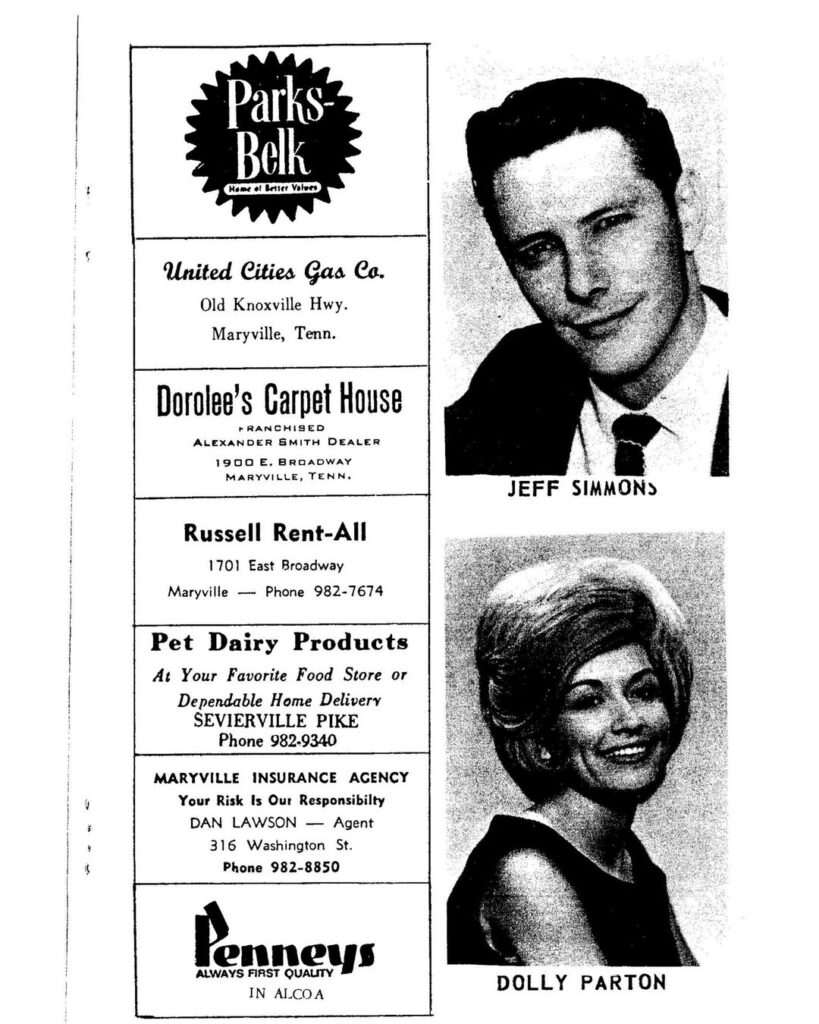
That was also the year that Dolly Parton made her final public appearance in Blount County, as one of the performers at the 14th annual Hillbilly Homecoming. Something of a precursor to the Foothills Fall Festival, the annual event promoted Appalachian art, music, crafts and culture, and in 1966, it ran from June 30 through July 2. A brochure at the Blount County Public Library advertises Dolly’s participation in that year’s event, but her setlist and the estimated attendance are lost to time. Given that she was primarily known as a songwriter at that point in her career, chances are she performed the Top 10 hit “Put It Off Until Tomorrow,” which had been recorded by Bill Phillips, and possibly the singles “Dumb Blonde” and “Something Fishy,” which would appear on her 1967 debut studio album “Hello, I’m Dolly.”
That same year, country music star Porter Wagoner invited her to join his popular syndicated television program, and while her name had begun to percolate in certain Nashville circles, her decision to partner with Wagoner was the break she had been waiting for.
For seven years, Parton appeared alongside Wagoner, performing before a national audience and developing into a household name. The pair recorded a string of successful duets, including “The Last Thing on My Mind,” “Burning the Midnight Oil” and “Please Don’t Stop Loving Me,” while Dolly’s solo career began gathering momentum. Songs such as “Joshua,” “Coat of Many Colors” and “Jolene” helped establish her as one of country music’s most distinctive new voices.
By the mid-1970s, she was ready to step out on her own. The separation from Wagoner was not without difficulty — both personal and professional — and eventually inspired one of the greatest songs of her career. “I Will Always Love You,” written as a farewell to Wagoner, became a No. 1 country hit for Parton in 1974 and would later become one of the most famous songs in the history of popular music.
“I didn’t want someone else’s money; I wanted my money,” Parton recalled of her separation from Wagoner during a 2011 interview with The Daily Times. “I didn’t want someone else’s fame; I wanted my fame. I just wanted to do good.”
From that point forward, her collaborations and interactions with her peers in the industry were always memorable — for the manner in which she conducted herself, and for the authenticity of her efforts. There’s a reason everyone from Rob Halford of metal band Judas Priest to rap superstar Eminem wrote touching eulogies for her in the days after her passing: She was an influence on those with whom she collaborated, and an example to those who only knew her through reputation.
“Dolly was always the most professional, prepared and one of the funniest people I’ve ever worked with,” says Jeff King, another East Tennessean who grew up in the mountains and sought his fortune via music in Nashville. The son of the late Charles and Georgia King of the Dry Valley community just outside Townsend, King moved to Nashville in 1983 after graduating from Heritage High School, and after playing for some of Nashville’s biggest names, he’s been the guitarist for Reba since 2006.
That was the year, he said, that Country Music Television recorded a “CMT Giants” performance honoring Reba, and one of the special guests who tackled Reba’s vocals was Dolly Parton. There, on the stage of the Kodak Theater in Hollywood, a Townsend boy found himself playing guitar for a Sevier County girl, another serendipitous connection between two communities that share so much.
“She was the bright light of that night,” King says. “So professional, prepared, put together, and most of all, hilarious and very kind! She always said what she meant, and the gifts that she gave us in East Tennessee are immeasurable. Lots of kids learn to read because of her book-reading program, and she was just such a beautiful rose gone too early.”
After establishing a beachhead in the 1970s, she began to knock down one obstacle after another. Over the next half-century, Dolly Parton would become one of the most accomplished and honored entertainers in American history. She recorded dozens of studio albums, scored 25 No. 1 singles on the Billboard country charts and earned hits across multiple decades. Her songwriting catalog would produce standards that crossed genres and generations, while artists ranging from Whitney Houston to Miley Cyrus would introduce her work to entirely new audiences.
She became a crossover star in the late 1970s and early 1980s with songs like “Here You Come Again,” “9 to 5” and “Islands in the Stream,” while simultaneously conquering Hollywood. Her performances in “9 to 5,” “The Best Little Whorehouse in Texas,” “Steel Magnolias” and other films proved that the woman behind the rhinestones could command a screen just as easily as she could a stage.
Numerous trophies, plaques and other honors followed, and they kept coming. She was inducted into the Country Music Hall of Fame, the Songwriters Hall of Fame and the Rock & Roll Hall of Fame. She earned Grammy Awards and a Grammy Lifetime Achievement Award, as well as numerous Academy of Country Music and Country Music Association honors. She received nominations for Academy Awards, Emmy Awards and Tony Awards, earned Kennedy Center Honors and was recognized by the Library of Congress and countless other institutions.
She was, by almost any reasonable measure, a national treasure. But the remarkable thing about Dolly Parton is that the accumulation of accolades never seemed to become the point. She built Dollywood into one of the region’s most successful tourist destinations and expanded her reach into film, television, publishing, Broadway and business. Through her Imagination Library, she transformed a simple idea born from her father’s inability to read into an international literacy initiative that has placed millions upon millions of books into the hands of children.
And somehow, through all of it, she remained recognizable. Not in the sense that everyone knew the hair, the rhinestones and the plunging necklines, but in a much rarer way — across generations, political divisions, religions and cultures, people seemed to recognize something of themselves in her … and that’s likely because she never tried to pretend she came from anywhere else, she told The Daily Times during an in-person interview in 2011.
“I think when (people) see how hard I’ve worked, they say, ‘I don’t think that’s wrong, because that girl works her ass off,’” she said, sitting primly in the center of her own hall of fame. “I am one of them. I’m a country girl. I grew up with no electricity, no running water … it’s like I’ve lived (during) all these centuries in a way. These old-world songs, this mountain music — it’s embedded in my DNA.”
Daily Times reporter Steve Wildsmith (this writer) and photographer Joy Kimbrough made the trek to Dollywood that day, and for 15 minutes, Dolly addressed everything from her long music career to her theme park to the new tour she was preparing to launch with a performance at Food City Center, then known as Thompson-Boling Arena, in Knoxville. There’s no separation between personal and professional in those moments — numerous cousins and nieces and nephews, some of them barely old enough to walk, stroll freely throughout the building, stopping Dolly to ask questions or remind her of something.
Family, it appears, is still everything, and it’s little wonder she bought the land on Locust Ridge where she grew up in a two-room cabin … had the cabin restored … and then created an exact replica of it on the grounds of Dollywood. The original is on private property and not open to the public; the Dollywood facsimile was decorated by Dolly herself and features family photos from her personal collection. Family loyalty is a pillar of Southern Appalachian communities, and hers is no different.
She was a global superstar, but she remained a girl from the Smoky Mountains. She could stand on the world’s biggest stages while still speaking with the cadence of East Tennessee, that unmistakable twang she never tried to change or alter. She became fabulously wealthy without losing her memory of what it meant to grow up poor, and she could surround herself with glamour without ever entirely obscuring the woman underneath it.
“I get to dress in little costumes — I’m that much of a kid; I never got over that,” she said during that Daily Times interview. “I’m just the perfect person to have a theme park. I always say that I’m just the girl next door, providing you live next door to an amusement park.
“We’ve got the No. 1 park in the world right now, and we’re kind of wallowing around in that glory. I’m backed by so many great people. I’m not one to get out and brag and act like it’s all me — hopefully I’m not acting like it’s all me, because it’s certainly not — it takes a whole group of people to make everything work.”
And just like the community barn raisings and hog killings of old, back during the days when she wore clothes stitched together from scraps of previously worn garments assembled by her mama, she underscores an important part of her identity: Success is never carried on the backs of a single individual, and the more one acquires, the more obligated they are to give back to those who helped procure it.
“It ain’t about what all we can take — it’s about what we can give back,” she told this reporter, and her sincerity was evident despite the click-and-whir of dozens of cameras capturing her image in that moment. And she gave back, prodigiously. In October 2023, news broke that megastar Taylor Swift, who undoubtedly owes much of her success to the path blazed for her and so many other women artists by Dolly, became the first musician to reach billionaire status.
Dolly, however, could have set that bar years ago, had she chosen to pursue wealth over charity. It’s estimated that at the time of Parton’s death, her net worth was somewhere between $450 million and $600 million — a staggering fortune, though perhaps not as staggering as it might have been had she spent her life accumulating wealth rather than giving so much of it away. She gave back so consistently that it’s difficult to keep track of them all … but many of them forge a direct connection from her to Blount County.
Yes, her roots, her childhood and the empire she would eventually build were centered primarily in neighboring Sevier County. But the reach of her life and work was never confined there, because like the mountains themselves, Dolly’s influence spilled over borders and followed the roads, rivers, families and institutions that have long connected the communities of East Tennessee.
Perhaps nowhere is that more apparent than in the Great Smoky Mountains themselves. Through projects supporting Friends of the Smokies and its Trails Forever program, Dolly helped generate funding for the preservation and rehabilitation of trails within the national park, including work connected to the Tremont area and trails accessed through Townsend. The Great Smoky Mountains National Park, of course, belongs to no single county, and neither did Dolly’s affection for the landscape that shaped her. Her contributions helped support a place that Blount Countians know not as an abstraction or a tourist destination, but as part of the scenery of their everyday lives.
Her cultural influence also found its way into Blount County in ways that are harder to measure but no less real. Her music, stories and theatrical works have been presented locally, including productions at Maryville College and the Clayton Center for the Arts. These weren’t Dolly Parton productions, and there is no reason to suggest otherwise, but they are reminders of something remarkable about her legacy: the stories that emerged from a little girl growing up in the mountains became part of the cultural vocabulary of communities throughout the region and eventually, the world.
Even the broader network created by Dollywood extends into Blount County. The Dollywood Company has maintained a formal connection to the Blount County Chamber of Commerce, and Blount County residents have found professional opportunities within the orbit of Parton’s entertainment empire. Maryville College students find regular internships at the company, and the foundation associated with it has ensured that numerous individuals and organizations benefit from her philanthropy.
Cases in point: Maryville resident Gabe Brown, a graduate of both William Blount High School and Maryville College, received a Chasing Rainbows Award from the Dollywood Foundation, given to a teacher who had overcome adversity. He and his family were treated to a private ceremony at Dollywood, where the theme park’s matriarch gave a $1,000 donation to a charity of Brown’s choosing. Earlier this year, after East Tennessee Children’s Hospital was rechristened Dolly Parton Children’s Hospital following a gift of an undisclosed amount by Dolly, the name change echoed throughout the institution’s health care system, and today Dolly Parton Children’s Hospital Blount Outpatient Center is located on Fountain View Circle in Alcoa.
Another documented example is Alcoa teenager Tori Smith, who at 10 years old in 2017 was employed in a full-time performance role at Dollywood, portraying a young Parton and appearing in productions connected to the Imagination Library. One job does not make an economic impact study, of course, but it’s a small and wonderfully appropriate illustration of the way a girl from the Smokies could grow up in Blount County and find herself making a living portraying another girl from the Smokies.
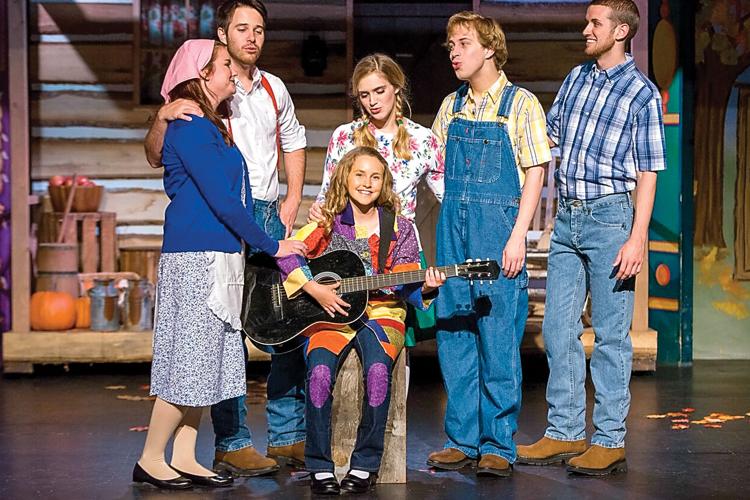
That may ultimately be the best way to understand Dolly Parton’s connection to Blount County: not as a claim of ownership, but as a shared inheritance.
Blount County did not make Dolly Parton. Sevier County can rightly claim that distinction, but the culture that shaped her worldview didn’t stop at the county line. The music she heard, the mountains she loved, the poverty she understood, the faith she celebrated, and the stories of mountain people finding humor and dignity in difficult circumstances belong to a much larger swath of Southern Appalachia, and for that matter, the world.
And over the course of eight decades, Dolly carried that world with her onto the stages of Nashville and Hollywood, into recording studios and theaters, into boardrooms and theme parks and libraries, and ultimately back into the communities that had given her so much in the first place. Sometimes her connection to Blount County was obvious: a guitar player on one of her first records, a teenage performance in Maryville or Townsend, family members seeking out Roy’s Record Shop, a local musician sharing a stage with her decades later.
Other times, it was quieter: trails winding through the Smokies, children receiving books, students finding opportunities within the world she built, nonprofits and institutions and various causes benefiting from her generosity.
Those connections may not have been enough to make Dolly Parton a Blount Countian, but then again, they were never meant to.
But they are enough to make her part of Blount County’s story.
And so, as this community joins the rest of the world in mourning a woman who somehow managed to become both larger than life and intimately familiar, perhaps the most appropriate place to look for her isn’t beneath the lights of Nashville or Hollywood, or even beneath the towering roller coasters of Dollywood.
Perhaps it’s closer to home … in the picking parlors at Rocky Branch or the summer camps at Maryville College put on by Steve Kaufman and his wife, Donna Dixon; maybe it’s the ghosts lingering around the shell of the building that once housed Murlin’s Music World or the whispered echoes emanating across the AM band late at night.
Maybe she’s still there in those places, where unknown musicians in Maryville and Townsend pick guitars in small rooms for audiences of 20 people, in the laughter spilling off the porch where a family has gathered after Sunday dinner, in a child who opens a book that arrived in the mail and discovers an entire world waiting inside it.
And maybe she’s there in the mountains themselves, in those fog-shrouded hills and tree-shadowed hollers, the creek branches running over ancient stones and the old-growth forests of the back country and along the winding roads that have carried generations of East Tennesseans from one county to another, rarely giving much thought to where one ended and the next began.
And somewhere in all of that — the mist and the music, the poverty and the pride, the heartbreak and the humor — is the shadow of a little girl in a coat stitched together from scraps, standing beside the bold and beautiful woman she would become: bedazzled and bejeweled, wrapped in rhinestones, impossible to ignore and somehow still unmistakably one of us.
Their reunion is undoubtedly a happy one, even as the rest of the world mourns her, claiming for itself a small piece of the forever queen of Southern Appalachia.
But while they grieve, the mountains and the people who call them home remember them both: the girl whose big dreams carried her to far-away places, and the woman who always knew her way back home.
We remember. And wherever we find ourselves on either side of some invisible county line, we celebrate the memories — grateful, perhaps, that the mountains never cared much for borders, and neither did she.