
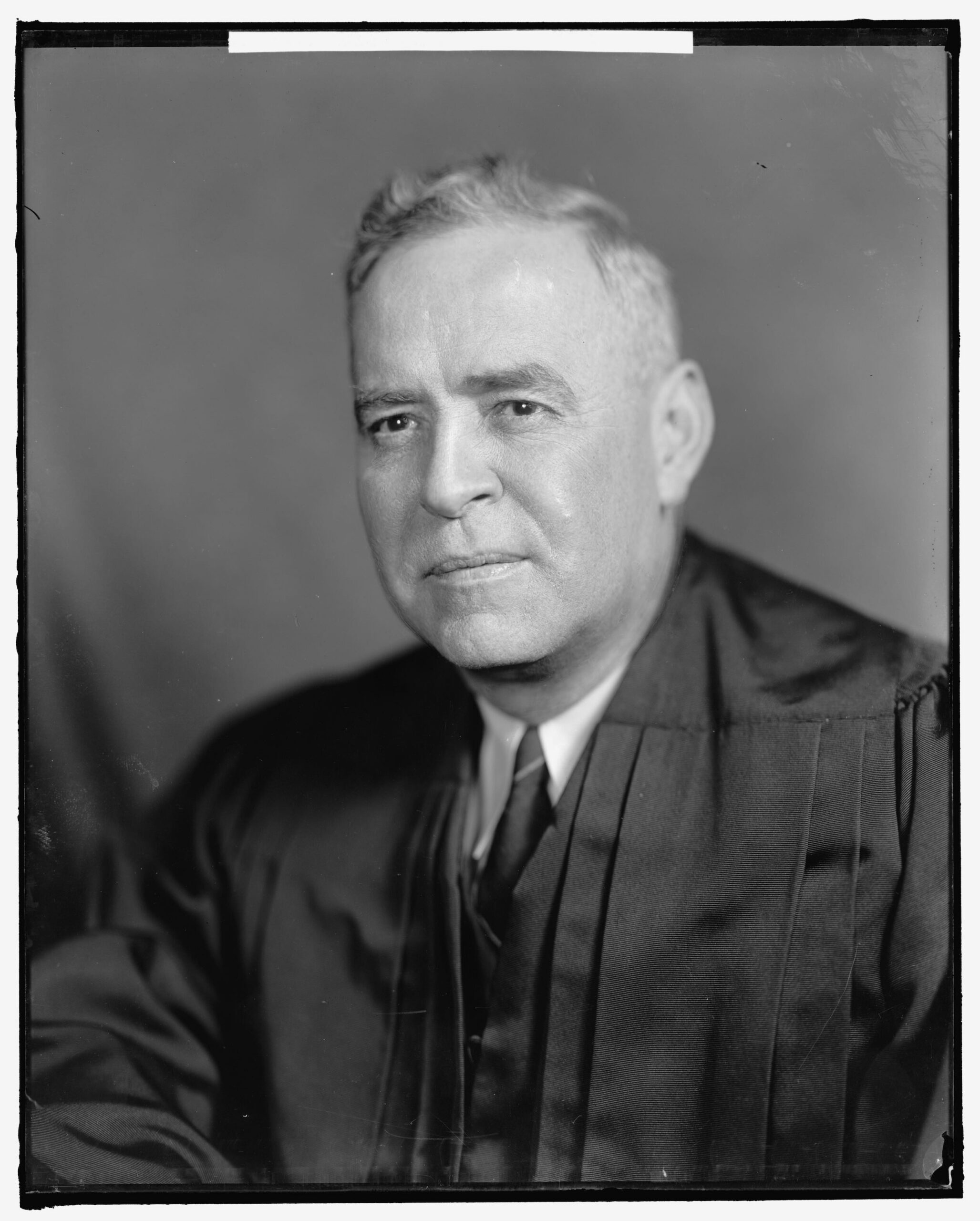
Editor’s note: Steve Wildsmith writes for us now and then, but today he’s wearing his Maryville College hat. He’s the assistant director of marketing and communications there, and this piece comes from the college, not our newsroom.
No one quite knows why Wiley Rutledge 1914 withdrew from Maryville College a year before he was to have graduated, but the man who would go on to greatness as a justice on the United States Supreme Court never forgot the educational foundation he received as a Scot.
According to his biographer, John M. Ferren — whose book “Salt of the Earth, Conscience of the Court: The Story of Justice Wiley Rutledge” was published in 2004 — Rutledge spoke often of the “fundamental education” he received at MC, of which he once wrote, “I, of course, owe more to Maryville College than I do perhaps to any of the other educational institutions which I attended.” He credited the institution for introducing him to “forms of thinking” rather than “substance of thought” and putting him “in real touch with real ideas.”
That idealism would guide most of the decisions he made on the Supreme Court after being appointed to it in 1943 by President Franklin D. Roosevelt. A strident defender of civil liberties, he earned both fame and disdain for dissenting in the In re Yamashita case of 1946, in which the majority ruled that military commanders can be held legally responsible for the war crimes of their men if they failed to show effort in uncovering and controlling such actions.
In his dissent, Rutledge argued that due process must be applied universally, even to a defeated enemy during wartime, and that the military tribunal that found Gen. Tomoyuki Yamashita — commander of Japanese forces in the Philippines during World War II — guilty did so in the absence of evidence that he personally ordered or knew about the atrocities.
“He dissented in the Yamashita case because he believed very strongly in personal liberty, and that was a very unpopular opinion,” said Dorsey “Dan” Ellis ’60, himself a former jurist who developed a keen interest in Rutledge’s career after discovering so many of the similarities to his own. “The war was only recently over, and there was a lot of publicity about the Japanese atrocities, but there was no evidence of [Yamashita’s] participation in them or of his support for them. But because he was the high-ranking general in charge of the Japanese occupation, he became the masthead for that.”
Although Rutledge died in 1949, his legacy survived him, and as Ellis earned his own law degree, he discovered that their paths seemed to be linked by more than their ties to College Hill. Both served as dean of Washington University School of Law in St. Louis — Rutledge from 1930 to 1935, and Ellis from 1987 to 1998 — and both were employed by the University of Iowa. (Ellis began his teaching career there as a professor of law, and Rutledge was the dean from 1935 to 1939.)
Both men were sons of Southern ministers, enjoyed fly fishing and had a mutual passion for legal history, so much so that when Ferren began his research on the Rutledge biography, Ellis stepped up to make introductions and suggest directions.
“I served as kind of a middle person there, because I put the author in touch with members of the (Maryville College) faculty who had known Justice Rutledge back then,” said Ellis, who recently endowed the Ellis Center for Faculty and Student Excellence at Maryville College, which bears both his name and that of his late wife, Sondra Wagner Ellis ’60. “Indirectly, as both a faculty member at Iowa and the dean at Washington University, I felt like I ought to live up to the reputation of Wiley Rutledge.”
Rutledge was born in 1894 in Cloverport, Kentucky, and in 1908, his father — Wiley Blount Rutledge Sr., a Southern Baptist minister — accepted a pastorate at First Baptist Church of Maryville, and in 1908, his son enrolled in the preparatory department at Maryville College. In 1910, with a budding interest in the law, Rutledge switched to a degree track at MC, uninterested in the University of Tennessee-Knoxville because of its much larger size. According to Ferren, “Wiley flourished at Maryville and made lifelong friends there. He had an outstanding academic record, with most grades in the 90s or high 80s. He majored in Latin and Greek while taking courses in mathematics, English, philosophy and the sciences.”
“He was very active on campus,” said Amy Lundell ’06, Maryville College archivist. “He participated in intramural sports, debate and a number of clubs and organizations. He was well-liked by all who knew him and was known for playing a practical joke or two on his friends. Dr. Ralph Waldo Lloyd 1915 (who would go on to serve as the College’s sixth president) ‘remember[ed] him as an alert active man who got along well with people and who was a good public speaker.’”
In a moment of prescience, the College yearbook in 1913 included a fake newspaper titled The Junior Daily Chronicle, Lundell added … in which a “court news” section referred to Rutledge as “Judge Rutledge” due to his presiding over a fictitious case. While the case, and the “court” itself, may have been invented by Rutledge’s fellow Scots for the sake of amusement, it was likely the first time Rutledge was referred to as a jurist … although it certainly wouldn’t be the last. Besides, as a member of the debate team, he was already preparing himself for the skills necessary in his future career, according to Lundell.
“According to formal debate rules, each party is assigned a position to debate on a question (affirmative or negative), so what the person argues is not always indicative of personal opinion or belief,” she said. “Though he wasn’t able to choose a specific position to argue, he would have been exposed to all sides of an issue through his research and debate preparation. This certainly would have taught him how to analyze topics and arguments within a personal and legal context.”
Occasionally, that meant arguing positions that would be considered offensive by today’s standards. For example, a 1910 Junior Section Alpha Sigma vs. Athenian Preparatory Students debate saw him argue against foreign immigration as an advantage to the South.
“Maryville College has a strong history of encouraging debate on political and social issues,” Lundell said. “Debate and public speaking skills were part of the curriculum from its founding. In particular, debate formed the foundation of the purpose of the literary societies throughout their existence, dating back to when they were created in 1828.
“Debate topics were chosen from current political, social, religious, and cultural contexts of the day. They were not afraid of difficult topics, as students were debating slavery, immigration, war, the death penalty and the education of women as of the 1830s. If it was important to the students, the local community, the state, the country or the world, they debated it.”
During his sophomore year, Rutledge was introduced to the College’s newest Greek teacher, Ferren writes — Annabel Person, who, although five years older, would become Rutledge’s wife.
“Wiley fell for her virtually on sight,” Ferren writes. “He called Annabel for a date, and she said no, perhaps feeling it would be inappropriate for a teacher to date a student. But he persisted, insisting that he could not hear her over the phone and replying that he would be over to pick her up. She did not turn him away; a lifelong love for both of them began.”
In 1913, however, Rutledge arrived at a life-changing decision: He wanted to start a career in order to provide for himself and Person, which law school would delay. While his lowest grades were in the sciences, he opted to pursue chemistry at the University of Wisconsin in Madison, believing that a degree from an institution better known for science education would best serve that path.
“Hearing of Wiley’s plans, the president of Maryville College (Dr. Samuel Tyndale Wilson 1878), alarmed at the prospect of losing one of Maryville’s top students, offered him a scholarship for his senior year covering ‘full tuition and room rent,’” Ferren writes. “But Wiley declined.”
“It was quite common for students to not graduate at that time,” Lundell said. “Some students only came for a few classes at the preparatory level (the pre-college high school track that was discontinued at MC in 1925); others took the classes necessary for their preferred line of work; some needed to drop out for financial/family/health reasons, and most women left the college if they got married.
“There are a few cases where a student left Maryville to attend a different college, but it does not appear to have been common. In fact, we usually have one or two senior students each year who note that they have come from another institution but are finishing at Maryville.”
Despite his withdrawal, Rutledge acknowledged that he had been forever changed by Maryville College’s liberal arts tradition and by its progressive nature: As a progressive institution that admitted both women and Black students until Tennessee made it a crime in 1901 to educate Black and White students together, Maryville College helped him to see that “a rigid fundamentalism of religious belief” leads to “a closed mind and intolerance toward others.” He came to abhor sectarian behavior, Ferren notes, and would later admit that his Baptist faith was “not quite right.”
Neither, however, was chemistry. Although he graduated from UW-Madison in 1914 with a degree in the field, he opted to return to a pursuit of a law degree, enrolling first at Indiana University Law School while he taught secondary education on the side. In 1915, he was afflicted with a case of tuberculosis, taking time off to recover at a sanatorium and marry Person. Together, they moved to Albuquerque, New Mexico, where Rutledge taught high school business classes alongside his old Maryville College debate partner and friend, Addison Moore 1914.
In 1920, he enrolled at the University of Colorado Law School in Boulder and graduated with a law degree in 1922. After passing the bar, he immediately went to work at a Boulder-based firm, and two years later was teaching the law at CU Boulder. A full professorship at Washington University in St. Louis opened up in 1926, and four years later, Rutledge was the dean of that law school. In 1935, he accepted the deanship at the University of Iowa College of Law, and years later, his impact remained evident at both institutions, Ellis said.
“In a sense, it felt like he was looking over my shoulder,” Ellis said. “His materials in the law libraries at both schools were still there, and we even had a mock court competition named for him.”
As an educator, he often weighed in on the pressing legal issues of the day, particularly on the New Deal-era plans by President Roosevelt that were often stymied by the Supreme Court of that day. When Roosevelt advocated for “packing the court” in 1937 — adding more justices in an attempt to override partisanship, a controversial position that was resurrected after Senate Republicans blocked Merrick Garland’s nomination to the court in 2016 — Rutledge voiced his support. Such a position was extremely unpopular in the Midwest, and it led some members of the Iowa government to float the idea of freezing University of Iowa faculty salaries … but it also put Rutledge on Roosevelt’s radar, and in 1939, Roosevelt nominated Rutledge to the United States Court of Appeals for the District of Columbia.
Over the next four years, Rutledge authored 118 opinions that legal scholar William Wiecek said “reflected his sympathetic views toward organized labor, the New Deal and noneconomic individual rights.” In 1942, when Justice James F. Byrnes resigned from the court, a handful of other appointees were considered, but Rutledge’s friends and admirers in the media began a campaign to secure him the nomination.
Rutledge himself wrote to Attorney General Francis Biddle to deny any interest in actively seeking the position (he did not “have Supreme Courtitis,” he said in the letter), although he “made clear to a few friends that he would not necessarily turn down the seat if offered; he felt a strong sense of obligation to Roosevelt,” Ferren writes.
While other members of the court pressed for an alternate nomination — Judge Learned Hand, of the U.S. Court of Appeals for the Second Circuit in New York — columnist Irving Brant of the St. Louis Star-Times, whose editorials defending the New Deal inspired Roosevelt’s failed bill to expand the court majority, convinced Roosevelt that Rutledge was the right candidate for the job. The offer was extended, the Senate confirmed the nomination, and on Feb. 15, 1943, Rutledge was sworn in as the 84th justice of the Supreme Court of the United States.
His interpretation of the law, said Dr. Mark O’Gorman — political science professor at Maryville College — would come to define him as a maverick who went against the grain.
“Wiley Rutledge had a short career on the court, dying after only six years on the court,” O’Gorman said. “And many times, Rutledge found himself on the dissenting side of many SCOTUS decisions during his career. But some legal scholars think he was ahead of his time, in advocating for the rights of the individual, and in his passionate defense of American due process — ideas that only gained traction decades later with decisions by the Warren Court of the 1960s (mandating Miranda Rights be read to accused criminals at the moment of arrest; prohibiting use in court of evidence gathered without a search warrant).”
Along with Justice Frank Murphy, O’Gorman pointed out, Rutledge was a consistent dissenter against the conservative lean of the court in those days, In re Yamashita serving as a prime example.
“Most of the court said that Yamashita should still be tried in a military tribunal,” O’Gorman said. “Rutledge and Murphy both dissented, saying Yamashita deserved due process. Just as the words of much of the Bill of Rights suggest, they believed it should be provided to anyone in a U.S. court.”
Advocating for certain positions, even when in the minority and with certainty that the majority opinion will prevail, is at the heart of Rutledge’s contributions to U.S. jurisprudence, O’Gorman added.
“I recall a couple of times, when guests to the College (and the occasional political science professor) tell MC students that times will come in their lives when their opinion will not be in the majority, but it will need to be stated anyway, and passionately, to make sure all sides are heard,” he said. “Some issues with a moral center must be championed, and it’s important to realize that the U.S. Constitution works best when — in word and deed — it provides equal justice under law.”
In the classroom of O’Gorman and other MC educators over the years, Maryville College’s own Wiley Rutledge has been used as such an example. In 2007, Ferren was asked to deliver the Commencement address, and in so doing, he recalled Rutledge’s dedication to the law over partisanship, and encouraged members of the Class of 2007 to follow suit.
“Within a few years after the Supreme Court decided Yamashita, courts around the world began to follow the Rutledge dissent, holding that a commander’s criminal responsibility for war crimes committed by his troops is limited to crimes the commander knew, or had reason to know, about,” Ferren said, adding that the dissent brought about clarification of the Uniform Code of Military Justice and amendments to the Geneva Conventions.
“Can you imagine the courage it took to cast that vote and write that dissent in Yamashita? — to say that our government had not given a fair trial to a Japanese general whose troops had butchered over 25,000 civilians, including children? Our country was ready for vengeance. From Tokyo, Gen. [Douglas] MacArthur denounced Rutledge and his colleague in dissent, Justice Frank Murphy. But Wiley Rutledge was, above all, a servant of the law, wherever it took him.”
While his positions occasionally made him unpopular, Rutledge found comfort in the knowledge he had gained decades earlier at Maryville College. His ties to the institution remained strong, and for the last decade of his life, he corresponded with individuals at the College frequently, Lundell said.
In fact, in 1945, Rutledge returned to MC to deliver a Founder’s Day speech on Oct. 27. Titled “Who Has Won the War,” his speech was a rallying cry for a post-World War II society that valued human lives over arms and “neighborly participation in the greatest of common affairs to withdrawal.”
“We have yet a chance to win the war,” he told those in attendance. “But whether we shall win it will depend not on our immediate victory by force, but upon whether we have the vision and the capacity to make that victory a tool for fashioning conditions and values which will make the great price we and the world have paid for it worthwhile. If we have won at arms, only to repeat our former and almost fatal error, we shall not have won the war. We shall only have lost all that the war was fought to keep and create.”
At those Founder’s Day services, the College conferred upon Rutledge an Honorary Degree of Doctor of Laws, and many of Rutledge’s former classmates returned to campus to catch up with the peer now serving on the highest court in the land.
“I believe it was pretty significant for MC to host a sitting Supreme Court justice,” Lundell said. “It made all the local newspapers with text and photos, and many of his classmates and other judicial alumni came back for Alumni Day to meet up with him.”
A year later, it seems, the College bestowed upon him his Bachelor of Arts, even though he never graduated from MC.
“According to a letter from Rutledge to Lloyd dated May 10, 1946, Rutledge wrote, ‘Many thanks for your thoughtfulness in going to so many pains about the diploma,’” Lundell said. “He went on to write, ‘Really, it was not necessary at all for you to do this, but since you have gone to all the trouble, I am very happy to have that certificate of formal graduation from my real alma mater.
“‘I shall always treasure it but, even more, the occasion on which it was tendered and the thought of yourself and others which brought this about.’”
Always a man who placed unrelenting standards upon himself, by 1949, Rutledge was suffering from exhaustion. Although on vacation at the time, Rutledge suffered a hemorrhagic stroke in August 1949, lingering for several days before finally dying on Sept. 10.
Three days later, a small memorial service was held during the weekly Chapel service at Maryville College, and Lloyd gave an emotional eulogy to his friend and fellow Scot.
“This was important to the nation, and it has a special concern for Maryville College because he was a student here for five years and received the honorary degree of Doctor of Laws here in 1945,” Lloyd said. “While it is not practicable or possible for us to commemorate publicly the lives and deaths of more than a few of our former students, it seems fitting that this College give some recognition to the death of the first of its students to be a member of the Supreme Court of the United States.”
He was, in other words, a “true Maryville College man,” Lundell said, pointing to Lloyd’s notation in the memorial service that Rutledge occasionally attended Maryville College alumni gatherings when he lived in Washington, D.C.
“Though he officially graduated from the University of Wisconsin, he always considered Maryville College his ‘true alma mater,’” Lundell said. “He was heavily involved with academic and social pursuits on campus and met his wife here. In later years, he gave a speech to MC alumni where he credited MC with providing his educational foundation by teaching how to think and not just what to think … how to understand all sides of an issue in a debate … ‘an appreciation of the earth and its beauty’ … and ‘especially a foundation for idealism and service to others.’”
Steve Wildsmith is the assistant director of marketing and communications at Maryville College and an occasional contributor to Let’s Be Blount.
About Maryville College: Maryville College is a nationally ranked institution of higher learning and one of America’s oldest colleges. For more than 200 years, we’ve educated students to be giving citizens and gifted leaders, to study everything, so that they are prepared for anything — to address any problem, engage with any audience and launch successful careers right away. Located in Maryville, Tennessee, between the Great Smoky Mountains National Park and the city of Knoxville, Maryville College offers nearly 1,200 students from around the world both the beauty of a rural setting and the advantages of an urban center, as well as 70 majors, seven pre-professional programs and career preparation from their first day on campus to their last. Today, our 10,000 alumni are living life strong of mind and brave of heart and are prepared, in the words of our Presbyterian founder, to “do good on the largest possible scale.”